
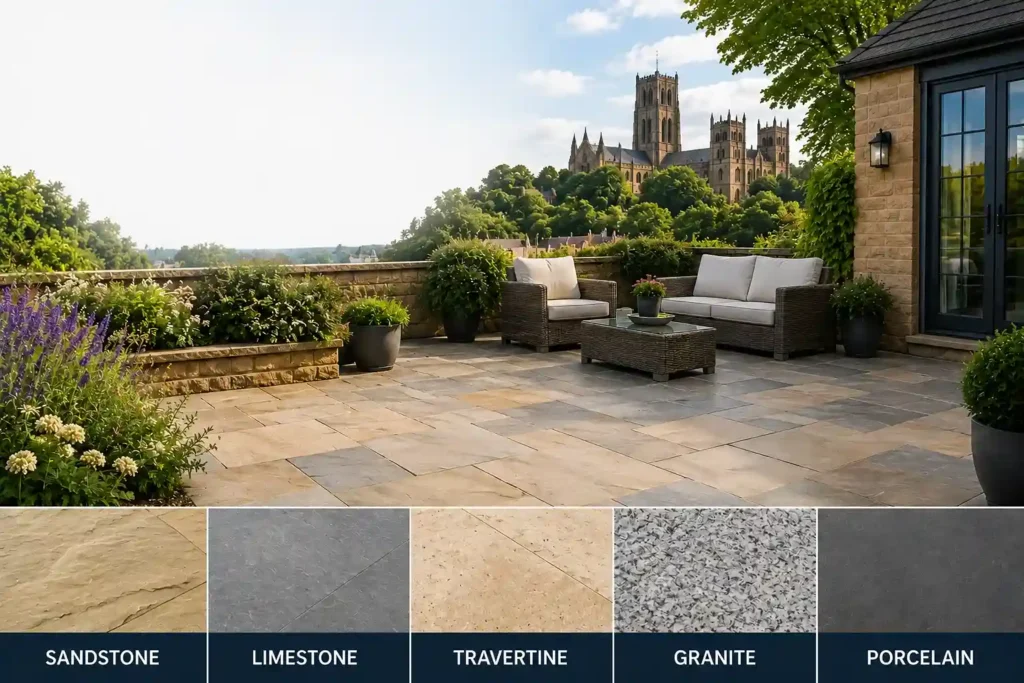
Ever looked at your patio after a long Durham winter and felt your heart sink? Green patches, slippery slabs, cracks creeping along the joints — it’s a common sight up here. The simple truth is that not every paving stone can handle our weather. We’ve laid patios across County Durham for years, and one question comes up again and again: Which stone should I actually choose? It sounds easy, but it’s not. The right choice depends on your garden, your budget, the look you love, and most of all, our cold, wet North East climate. A stone that dazzles in a showroom down South can crumble through a frosty Durham January.
Why Durham’s Climate Changes Everything
Before we talk colours and finishes, we need to talk weather. It matters more than you’d think. Durham is wetter and colder than much of England — around 182 rainy days a year, frost on most winter nights from November to April, and snow on roughly 14 days. Here’s the problem with the wrong stone: porous slabs soak up rainwater. When that water freezes, it expands. Repeat that freeze-thaw cycle all winter, and softer stone can crack, flake, or work loose. It’s the number one cause of patio failure we’re called out to fix.
The Main Contenders: Patio Stone Options Compared
There’s no single best stone — only the best stone for your situation. Here are the materials we genuinely rate, and where each one shines.
Sandstone — The Popular All-Rounder
Indian sandstone remains the most popular natural stone choice across the UK, and for good reason. It offers gorgeous natural colour variation, a textured riven surface that grips well underfoot, and a warm, characterful look that suits Durham’s older stone-built homes and cottages beautifully. Shades like Kandla Grey, Raj Green, and Autumn Brown each give a different feel — from cool neutral greys to earthy browns.
Sandstone is also one of the more affordable natural options, which is part of why it’s so widely chosen by homeowners working with professional Patio Fitters in Durham. The catch? Sandstone is porous. To stand up to our winters, it needs proper sealing every one to three years and, more importantly, a correct installation with a full mortar bed and a slurry primer on the back of each slab. Get the laying right, and a quality sandstone patio will comfortably last decades in Durham.
Best for: traditional gardens, period properties, and homeowners wanting natural charm at a sensible price.
Limestone — Refined and Elegant
If sandstone is rustic, limestone is its more polished cousin. It has a smoother, more consistent appearance with softer, warmer tones — a favourite for clean, design-led gardens and contemporary planting schemes. The honesty bit: limestone is also porous and arguably needs even more careful specification than sandstone. It must be sealed properly and laid on a full-contact bed to avoid staining and weathering. It’s a beautiful stone, but it rewards a skilled installer and punishes a rushed one.
Best for: modern, minimalist gardens where a refined, uniform look matters.
Granite — The Tough One
When durability is your top priority, granite is hard to beat. It’s naturally dense, extremely hard-wearing, and genuinely frost-resistant — which makes it arguably the most forgiving natural stone for a place like Durham. It needs very little protection from the elements. It typically costs more than sandstone, and its appearance is a touch more uniform, but if you want a patio you can largely forget about, granite earns its keep.
Best for: high-traffic areas, long-term peace of mind, and gardens exposed to the worst of the weather.
Porcelain — The Modern Low-Maintenance Champion
Porcelain has surged in popularity over the last few years, and honestly, it’s well-suited to the British climate. Made from clay, sand, and minerals fired at high temperature, it’s non-porous, exceptionally tough, and resistant to frost, staining, and fading. Because it doesn’t absorb water, porcelain sidesteps the freeze-thaw problem almost entirely — and it needs no sealing.
Many slabs are slip-rated and stay comfortable underfoot. You can get porcelain that convincingly mimics natural stone or timber, giving you a modern finish with minimal upkeep. The trade-offs: it costs more upfront, and it demands precise installation, as the slabs must be laid with the right adhesive and falls. It also has a more uniform, contemporary feel that won’t suit everyone.
Best for: modern gardens and busy homeowners who want a lay it and leave it patio.
So, Which Stone Is Actually Best for Durham?
Here’s our honest verdict after years of working in this climate:
- For the best balance of looks, value, and tradition: quality sandstone, properly sealed and laid.
- For maximum durability with minimal fuss: granite or porcelain.
- For a refined, modern aesthetic: limestone or porcelain.
- For the lowest long-term maintenance: porcelain, every time.
But — and this is the part the showrooms won’t tell you — the stone you choose matters less than how it’s installed. A premium slab laid on a poor sub-base, without proper falls for water run-off and without a slurry primer, will fail far sooner than a budget stone laid correctly. In Durham’s freeze-thaw climate, the foundation beneath your patio is every bit as important as the surface on top.
Don’t Forget the Finish
One quick word of warning: honed and polished finishes look lovely but can become dangerously slippery when wet — and in Durham, wet is most of the year. For outdoor use, always check the slip rating and lean towards textured, riven, or anti-slip finishes. Your future self, crossing the patio on a frosty morning, will thank you.
Get It Right the First Time with Landscapers Durham
Choosing the right patio stone is a genuine investment in your home — and it’s one worth getting right. At Landscapers Durham, we don’t just sell you a slab and disappear. We assess your garden, your aspect, your drainage, and how you actually want to use the space, then recommend the stone that will look brilliant and survive everything the North East throws at it.
From the first design sketch to the final jointing, we install to modern industry standards — proper sub-bases, correct falls, slurry-primed slabs, the lot. That’s how you get a patio that still looks superb in fifteen years, not fifteen months.
Frequently Asked Questions
What is the best patio stone for the Durham climate?
Porcelain and granite are toughest — both resist frost and barely absorb water. For a natural look, sealed sandstone works well too.
Is sandstone or porcelain better for a patio?
Sandstone offers natural charm at a lower price but needs sealing. Porcelain costs more but is frost-proof and almost maintenance-free.
Do I need to seal a natural stone patio in Durham?
Yes. Seal sandstone and limestone every one to three years to stop water freezing inside. Porcelain and granite don’t need it.
Why do patios crack or come loose over winter?
The freeze-thaw cycle. Trapped water freezes, expands, and cracks the stone. Proper installation prevents it.
How much does a new patio cost in Durham?
It depends on the stone, size, and groundwork. A free site visit gives you an accurate quote.
Which patio finish is safest in wet weather?
Textured, riven, or anti-slip finishes. Avoid polished slabs — they’re slippery when wet.

